
Why Custom Software Beats Off-the-Shelf Solutions for Growing Businesses
There is a persistent myth in the small and medium business community that custom software is a luxury reserved for large enterprises with deep pockets. The conventional wisdom suggests that off-the-shelf solutions are the sensible, budget-friendly choice for businesses that need to watch every penny. Yet this assumption frequently costs SMBs far more than they realise in lost efficiency, suboptimal processes, and limited growth potential.
The truth is that custom software has become increasingly accessible, and for many growing businesses, it represents a smarter investment than off-the-shelf alternatives. This article explores why custom software often beats ready-made solutions for SMBs, when to make the switch, and how to evaluate whether custom development is right for your organisation.
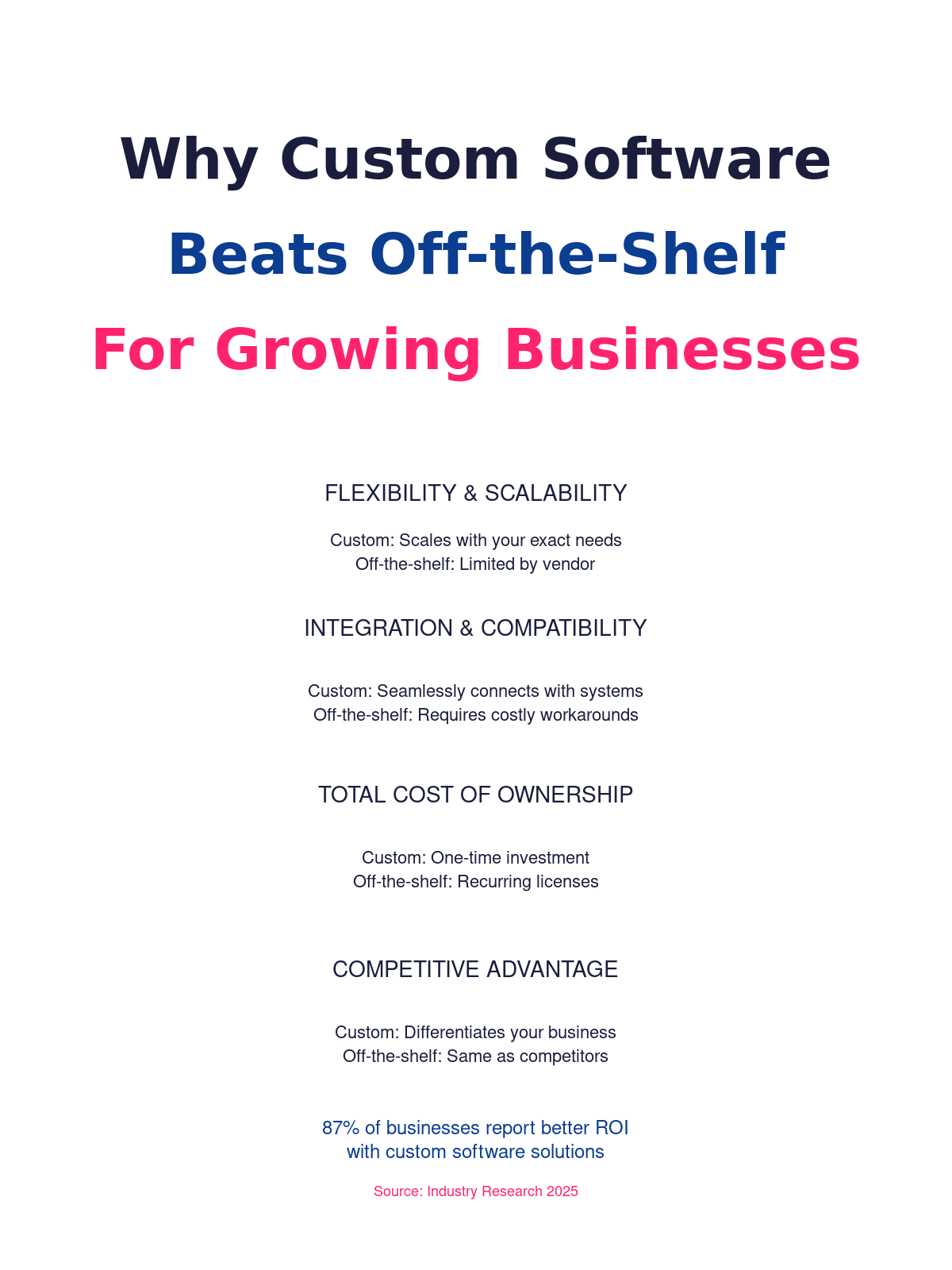
In this guide, we explore the hidden costs of off-the-shelf solutions, the advantages of custom software for growing businesses, and how to determine whether custom development is the right choice for your organisation.
Advert
Our services
TO Digital Tech
The Misconception: Custom Software Is Only for Big Business
Walk into any business networking event or browse through SMB forums, and you will hear the same sentiment repeated: “We are too small for custom software.” This assumption is understandable. A decade ago, bespoke software development required significant capital, lengthy development cycles, and dedicated technical teams. The landscape has shifted dramatically.
Modern development tools, cloud infrastructure, and agile methodologies have dramatically reduced the cost and time required to build custom solutions. What once took months and hundreds of thousands of pounds can now be accomplished in weeks at a fraction of the cost. The playing field has levelled, yet the perception has not caught up.
The real question SMBs should be asking is not “Can we afford custom software?” but rather “Can we afford not to invest in a solution that truly fits our business?”
The Hidden Costs of Off-the-Shelf Solutions
At first glance, off-the-shelf software appears more economical. Subscription fees are predictable, implementation seems straightforward, and the vendor handles updates and maintenance. However, looking beneath the surface reveals a different picture.
Paying for Features You Never Use
Every pound spent on software features that do not serve your business is wasted money. Off-the-shelf solutions are built to appeal to the broadest possible market, which means they include functionality designed for industries, workflows, and company sizes that may have nothing to do with your operations. You are essentially subsidising features that will never benefit your organisation.
Research indicates that businesses typically use only 20-30 percent of the features available in their off-the-shelf software, yet they pay for 100 percent. Gartner Research
Integration Challenges
Modern businesses run on multiple software systems: accounting platforms, CRM tools, inventory management, marketing automation, and more. Off-the-shelf solutions rarely integrate seamlessly with your existing stack, leading to duplicate data entry, sync errors, and manual workarounds that consume staff time and introduce errors.
Custom software can be built from the ground up to integrate precisely with the systems you use, eliminating these friction points and creating a unified operational foundation.
Vendor Lock-In and Rising Costs
Subscription pricing seems manageable initially, but prices have a tendency to rise. Vendors count on your dependency on their platform, making it increasingly expensive to switch. What starts as a nominal monthly fee can balloon into a significant operational cost over three to five years.
Additionally, when the vendor discontinues a product, changes features you rely on, or experiences service issues, you have limited recourse. You are building your business processes on someone else’s terms.
Security and Compliance Blind Spots
Off-the-shelf software presents a broader attack surface because it serves thousands or millions of users. Vulnerabilities affect all customers simultaneously, and you are dependent on the vendor’s security response. For businesses handling sensitive data or operating in regulated industries, this creates compliance challenges and potential risk exposure.
Advert
Our services
TO Digital Tech
The Advantages of Custom Software for Growing Businesses
Custom software flips the equation. Instead of adapting your business to fit a generic solution, you build technology that serves your specific needs, processes, and growth trajectory.
Perfect Fit for Your Business Processes
Every business has unique workflows that differentiate it from competitors. Custom software accommodates these nuances rather than forcing you to work around limitations. If your sales process follows a specific qualification sequence, your inventory management requires particular rules, or your customer service has distinct escalation paths, custom software mirrors these processes exactly.
The result is faster adoption by staff, fewer errors, and processes that feel natural rather than contrived.
Scalability That Matches Your Growth
Growing businesses need technology that grows with them. Off-the-shelf solutions often impose artificial limits: per-user pricing that makes expansion expensive, feature tiers that restrict functionality as you grow, or performance caps that cause slowdowns at peak times.
Custom software scales exactly as needed. You pay for what you use, and the architecture supports your growth trajectory without forcing expensive migrations or platform changes.
Total Cost of Ownership
While the upfront investment in custom software may appear higher, the total cost of ownership over five to seven years is frequently lower. You eliminate ongoing subscription fees, avoid paying for unused features, and reduce the integration and workaround costs that accumulate with off-the-shelf solutions.
Many SMBs find that their custom software pays for itself within two to three years through operational efficiencies and eliminated licensing costs. Forrester Research
Competitive Differentiation
When your competitors rely on the same off-the-shelf tools you do, you are operating on a level playing field. Custom software creates genuine competitive advantage by enabling processes, customer experiences, and operational efficiencies that others cannot easily replicate.
Your technology becomes part of your strategic differentiation, not just a utility function.
Complete Ownership and Control
With custom software, you own the codebase, the data, and the roadmap. You are not at the mercy of vendor decisions, price increases, or product discontinuations. If you need to add functionality, modify workflows, or pivot your business model, your software adapts to you rather than the reverse.
Advert
Our services
TO Digital Tech
When Custom Software Makes Sense
Custom development is not the right answer for every situation. Understanding when it makes sense helps avoid unnecessary investment.
Your Business Has Unique Processes
If your operations involve workflows that do not fit neatly into standard software categories, custom development is likely worthwhile. Specialised industries, novel business models, and companies with proprietary methodologies benefit significantly from tailored solutions.
You Are Planning Significant Growth
Businesses expecting substantial growth should consider custom software early. Building on a scalable foundation prevents expensive re-platforming later and ensures your technology supports rather than constrains expansion.
Integration Complexity Is High
If your business runs on multiple systems that need tight integration, custom development often proves more cost-effective than the ongoing workarounds required with off-the-shelf solutions.
Data Security and Compliance Are Critical
Industries with strict regulatory requirements, such as healthcare, finance, or legal services, may find that custom software provides better security postures and easier compliance management than generalised solutions.
Long-Term Cost Efficiency Is the Goal
If you plan to be in business for many years, the accumulated savings from custom software versus rising subscription fees can be substantial. The longer your time horizon, the more compelling the custom investment becomes.
Making the Decision: Practical Considerations
Before committing to custom development, evaluate your organisation honestly.
Budget reality: Custom software requires upfront investment. If cash flow is severely constrained, subscription solutions may be more practical in the short term. However, consider the multi-year cost rather than just the immediate expense.
Technical readiness: Custom software still requires internal capability to define requirements, test functionality, and manage the relationship with a development partner. Ensure you have the internal resources or access to consultancy support.
Partner selection: The success of custom software depends heavily on your development partner. Look for firms that understand your industry, communicate clearly, and have proven track records with businesses similar to yours.
Scope clarity: Define what you need versus what would be nice to have. Starting with a minimum viable product that addresses core pain points reduces risk and provides faster value.